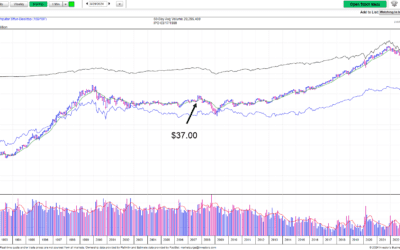
The fact that the price of a stock market average, like the S&P 500, is lower than it has been on average over the last 50 days is often a signal. A signal of what, you may ask? When a stock or ETF price closes lower than it has, on average, over the last 50 days, we can assume that it was not strong positive news that moved the index in a negative direction, as it’s reasonable to conclude the most likely influencing factor was bad news that caused the price to decline.
A “Tactical Investor” would act upon this by taking a slightly more conservative position in their portfolio. They may, for example, sell a risky stock or an underperforming one, and move that money into cash. If the news that drove the index below its 50-day average gets worse, the cash position will not lose value. Instead, it will earn positive interest.
A “buy and hold” investor will not raise cash but continue to hold, focusing on the long-term view. Which investor is “doing it right”? This depends on the strategy and risk tolerance of the portfolio.
All market corrections and bear markets begin with the stock market average dropping below its 50-day moving average. A drop below the 50-day does not mean the market will fall further or fail to rise quickly back above the 50-day moving average, but a tactical investor can act upon this in the interest of playing defense before they play offense.
A moving average is not the only data point utilized to make tactical changes to a portfolio. Some investors use observations from the business cycle to evaluate the performance of different industries. For example, when the market is coming out of a recession, it is believed that cyclical stocks will see large upswings in profitability. This may be a time to overweight cyclicals in your portfolio. Another example can be made with bonds. If interest rates appear to be on the rise (a condition which is very negative for bond holders), an investor may want to reduce exposure to bonds in his or her portfolio.
A Tactical Investing Strategy involves actively adjusting investment portfolios to capitalize on short-term market opportunities.